Growing up, my parents spent plenty of weekends watching me glued to the television set. Whether it was Saturday morning cartoons or my thirst for keeping up on sports of all types, I’d catch them giving me that classic parent look—the one that asked, “What good could possibly come from hours in front of the boob tube?”
Looking back now, I wonder if they’d still feel that way. Because while they thought I was just rotting my brain with animated slapstick and seasonal TV specials, I was actually getting a secret masterclass in world-class literature, poetry, opera, classical music, and fine art.
Who says pop culture can’t teach you a thing or two? Here is how television accidentally made me cultured.
1. Victorian Horror via Looney Tunes
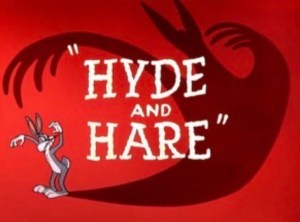
Before I ever picked up a book by Robert Louis Stevenson, I already knew all about the duality of man—thanks to that wonderful teacher himself, Bugs Bunny.
In the 1955 Warner Bros. Looney Tunes short Hyde and Hare, Bugs gets adopted by a mild-mannered gentleman in a park who turns out to be Dr. Jekyll. Every time the doctor drinks his potion, he transforms into a red-eyed, monstrous Mr.Hyde, leaving poor Bugs running for his life. Long before middle school English class forced me to read The Strange Case of Dr Jekyll and Mr Hyde, Friz Freleng’s cartoon had already introduced me to 19th-century gothic horror (and taught me a clever pun on “neither hide nor hair”).
“Eh, what’s up, Doc?” You go Bugs!
2. Symphony Halls via Walt Disney’s Fantasia
If you told me to sit still for two hours and listen to a bunch of orchestra symphonies without words, I would’ve probably looked at you strange. But wrap those symphonies in Disney hand-drawn animation, and suddenly it was magic.
Walt Disney’s landmark film Fantasia paired legendary symphonic suites with storytelling. I learned Paul Dukas’ The Sorcerer’s Apprentice through a panicked Mickey Mouse and multiplying broomsticks. I felt the raw weight of Igor Stravinsky’s The Rite of Spring set to the age of dinosaurs, and experienced Pyotr Ilyich Tchaikovsky’s The Nutcracker Suite through dancing fairies and mushrooms. It was high art delivered on a silver platter, er, better yet, via from heavy glass, silicon transistors, diodes, and circuit boards, and wooden or plastic cabinets.
3. Ludwig van Beethoven & Jazz via Charlie Brown
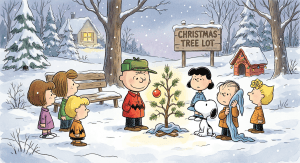
Every December, tuning into A Charlie Brown Christmas was a holiday tradition. Charlie Brown and the crew were a mark-your-calendar event. But beyond the tiny tree and Linus’s monologue, that special handed me my first real introduction to classical music appreciation and jazz.
Through Schroeder, a kid obsessed with his toy piano, I learned the name Ludwig van Beethoven before I ever even knew how to spell it. Combine that with Vince Guaraldi’s iconic soundtrack—including the timeless “Linus and Lucy”—and a cartoon about a depressed beagle gave kids like me a crash course in fine music history. (Of course, Snoopy also taught me a great history lesson on the Red Baron and, true or not, a lesson on how to treat others with kindness and respect.)
4. Charles Dickens via George C. Scott (and Michael Caine surrounded by a bunch of muppets)
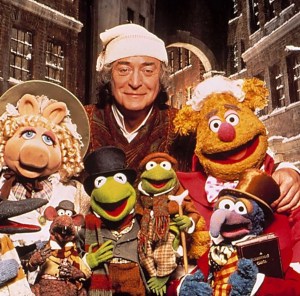
Every Christmas season, Charles Dickens’ 1843 novella A Christmas Carol took over the airwaves. Did I read the original manuscript first? Did I delight in Dickens’ masterful writing and prose? Absolutely not.
I learned the lessons of Ebenezer Scrooge, Jacob Marley, and the three ghosts through television. Whether it was George C. Scott delivering a masterclass in dramatic acting, Scrooged starring Bill Murray bringing a modern 1980s twist to the tale, or even The Muppet Christmas Carol, the core message of redemption and social responsibility came straight through the screen. I still contend that The Muppet Christmas Carol is one of, if not, the best versions of the story that you can watch or read each holiday.
5. William Shakespeare via Castaways, Trekkies, and Flintstones
Long before high school English class forced us to decipher iambic pentameter, pop culture was quietly feeding us the Bard of Avon.
In a legendary 1966 episode of Gilligan’s Island, the castaways staged a musical version of Hamlet set to the tunes of Bizet’s Carmen. Phil Silvers guest stars as a big-time producer, just one of dozens of people who come and go from the island while the castaways can’t figure out how to leave. I got my first taste of a Shakespearean soliloquy.
It wasn’t just Gilligan’s Island. Classic 70s and 80s TV shows like The Brady Bunch, Star Trek, Happy Days, and The Flintstones played on connections and Shakespeare themes.
6. Renaissance Murals via Saturday Morning Cartoons
Before kids ever stepped foot inside the Sistine Chapel, pop culture made sure they recognized Michelangelo’s The Creation of Adam.
That famous image—where God’s finger reaches out to touch Adam’s extended fingertip—has been spoofed everywhere from E.T. the Extra-Terrestrial (touching glowing fingertips) to SpongeBob SquarePants, The Muppets, and Family Guy. Pop culture took one of the most highbrow, sacred frescoes of the Italian Renaissance and turned its visual composition into shorthand for a miraculous connection.
7. Pointillism & Impressionism via Ferris Bueller’s Day Off
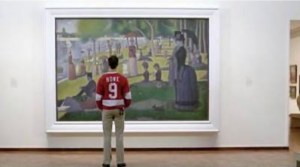
John Hughes’ 1986 classic Ferris Bueller’s Day Off gave an entire generation an unforgettable lesson in art appreciation.
During the trio’s trip to the Art Institute of Chicago, Cameron stands hypnotized in front of Georges Seurat’s massive 1884 masterpiece, A Sunday Afternoon on the Island of La Grande Jatte. As the camera zooms closer and closer into the canvas, the audience sees that the continuous image is actually composed of thousands of tiny individual color dots—explaining the technique of Pointillism better than any textbook could.
The Verdict
So those weekend marathon sessions weren’t a total waste. The boob tube didn’t numb our minds—it sneaked Stravinsky, Stevenson, Beethoven, Shakespeare, Michelangelo, and Dickens into my living room disguised as weekend entertainment.
Over to You!
What about you? What highbrow literary classic, piece of fine art, or orchestral masterpiece did you discover first through television or the movies? Did Bugs Bunny introduce you to grand opera, or did ET teach you fine art?
I know I’m missing a ton of high brow culture dressed up as pop culture references from over the years. Drop your favorite “accidental learning” pop culture memories in the comments below!
Discover more from Writing from the Heart with Brian
Subscribe to get the latest posts sent to your email.


Pop culture is a wonderful teacher and reflection of the times. For me, television, comics and music have been a refuge – and like you, I absolutely loved the Peanuts comics by Schulz. Rereading them as an adult reveals so many layers I never noticed as a child.
LikeLiked by 1 person