I got some great advice the other day. I was struggling with a work problem and I wasn’t sure how to deal with it. I picked up a small book that I keep on top of my desk and immediately came to some great advice and knew exactly how to fix the problem.
I’m not sure about you, but I wish all of life was that easy.
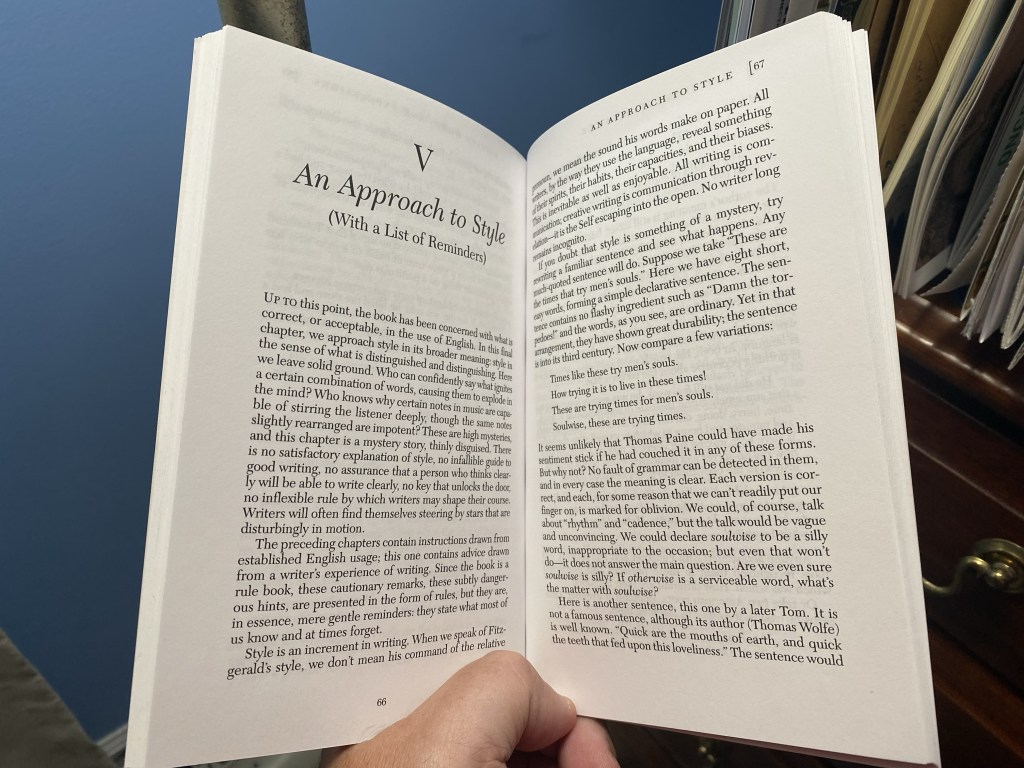
Best Selling Actor Brené Brown’s book The Gifts of Imperfection, has been sitting on my desk for months but the advice didn’t come from her. It wasn’t from any media sensations, TedTalk presenters, or business management gurus. The advice came from a simple American English writing style guide, The Elements of Style, by William Struck and E.B. White, first published more than 100 years ago. The original was published in 1918 by Strunk and then revised in 1959 by White.

The book offers writing advice such as putting statements in positive form, using active voice, and placing emphatic words of a sentence at the end. The book is common among writer types, it’s one of the go-to books for grammatical and punctuation issues, but tends to be less known by everyone else. The fourth edition paperback which sits in a prime spot on my desk has less than 106 pages.
I picked up the book the other day really as an after-thought, I was waiting for an online meeting to start and started to skim through the book. I wasn’t really focused at first, but the more I read the book, the more I found it helpful to the meeting that was about the start.
Here’s what I’m talking about:
When talking with others, talk with them, not at them:
- “When a sentence is made stronger, it usually becomes shorter. Thus, brevity is a by-product of vigor.”
- “Use the smallest word that does the job.”
When it comes to problems, get to the point:
- “A sentence should contain no unnecessary words, a paragraph no unnecessary sentences, for the same reason that a drawing should have no unnecessary lines and a machine no unnecessary parts.”
- “If those who have studied the art of writing are in accord on any one point, it is this: the surest way to arouse and hold the reader’s attention is by being specific, definite, and concrete.”
- “Instead of announcing what you are about to tell is interesting, make it so.”
Be truthful in your dealings:
- “A single overstatement, wherever or however it occurs, diminishes the whole, and a carefree superlative has the power to destroy, for the reader, the object of the writer’s enthusiasm.”
Be humble and modest:
- “A sentence should contain no unnecessary words, a paragraph no unnecessary sentences, for the same reason that a drawing should have no unnecessary lines and a machine no unnecessary parts.”
Measure twice, cut once:
- “The writer who has a definite meaning to express will not take refuge in such vagueness.”
- “Prefer the specific to the general, the definite to the vague, the concrete to the abstract.”
Forget about your problems, look for opportunities:
- “Consciously or unconsciously, the reader is dissatisfied with being told only what is not; he wishes to be told what is.”
English and Journalism teachers often refer to The Elements of Style as the Writer’s Bible. I’m not ready to start quoting from it chapter and verse quite like the Bible, but I have to admit that it’s got a ton of wisdom on both the written word and life.
Discover more from Writing from the Heart with Brian
Subscribe to get the latest posts sent to your email.


Great advice. I’d forgotten about that handy-dandy little book.
LikeLiked by 1 person
Yes, I still pull it out occasionally, still helpful! 😎😎😎
LikeLiked by 1 person
A favorite!
LikeLiked by 1 person
😎😎😎
LikeLike
I learned early on that good writing says the thing with the fewest words possible. I keep this in mind always. I’ve never read this book, and I especially like this one: “The writer who has a definite meaning to express will not take refuge in such vagueness.”
LikeLiked by 2 people
I used to hate math word problems, because if they were vague I was a mess. Need precision! Ha, ha.
LikeLiked by 1 person
🤣😅I just don’t like math…at all. But that’s hilarious. I hope if my son needs help, the word problems are concise.❤️
LikeLiked by 1 person
🙂 🙂 🙂
LikeLiked by 1 person
Sounds like that book might have some really great advice for those who make their career the art of writing. As someone who writes based on what I am thinking and feeling at the time I sit down to write, I am grateful to be pretty darn good at spelling, grammar and punctuation.
I have always been what I call a “circuitous writer“. I had bosses who appreciated that when they told me they needed to write a letter and then gave me two sentences to work with. Honestly, I write the way I think and my mind is usually on super speed.
LikeLike
The content is about writing style and tone, but I really think it’s about organizing your life and how to treat others, how to interact. I’m reading a lot into it, but that’s my takeaway.
LikeLike
Words to aspire to. 🤔
LikeLiked by 1 person
Yup, really about life. Thanks so much for stopping by.
LikeLiked by 1 person
Loved this Brian … I think I need to acquire a copy. I’ll check out Amazon once I get home. I think some of the wisdom you shared would benefit my students, maybe this needs to be on their reading lists
LikeLiked by 1 person
It was required reading when I was in college. Still appropriate today. It’s a small book, only about 100 pages. I’m not sure of price today, but mine says $10. Now it is based on US English … not sure if that matters. I would think still very helpful! 😎😎😎
LikeLiked by 1 person
The info you shared seems universal. 😁
I had a student today ask me if I’d mark him down if he uses American English lol. Only if he’s not consistent. I might want to correct all the missing “u” from words, but im not allowed 🤣🤭
LikeLiked by 1 person
Humour, harbour, neighbour! For a second though, I thought for sure you were commenting on our US need to say “um” after every other word. Ha ha ha! 😂😂😂
LikeLiked by 1 person
No … Labour, etc as you outlined above. You say ‘um’ … we say ‘eh’ … so we’re just as bad 😆
LikeLiked by 1 person
I have that very book…. now where is it? 🙂
LikeLiked by 2 people
Yup, that’s half of my problem! Ha ha ha
LikeLiked by 1 person
Haha! I feel ya.
LikeLiked by 1 person
I recognize that book–I plucked it up from next to a dumpster 15 years ago. 😂 I don’t have it anymore, but it was great, and I love how you apply the writing tips to others areas of life.
LikeLiked by 1 person
I’m probably pushing the advice a bit more than it was given but hey … still very helpful! 😎😎😎😎
LikeLiked by 1 person
This IS such a great little book. I was looking for something else last week and tripped over this gem and thought….I need to spend time with you again…but moved on to something else – whatever I was in search of. Thanks for the reminders of how powerful and useful it is. Time tested! 😉
LikeLiked by 2 people
Great minds think alike!!!!! 🙂 🙂 🙂
LikeLiked by 1 person
We could do a whole series on that one powerful little volume. And look at what you did here — pulling out some gems, for sure! 🥰
LikeLiked by 1 person
I was introduced to Strunk and White by my favorite journalism professor. He was a veteran editor of a city newspaper who worked as a professor in “retirement.” He took 12 students to the Capitol in Washington state for a semester each year. We were assigned to newspapers and thrown into being stringers, reporting daily news. It was an experience I’ll never forget that prepared me for my career. I still use Strunk and White.
LikeLiked by 1 person
Oh, wow, that sounds like an amazing experience! Yes, I still pull my copy out too. I had buy a new one a few years ago. My original got some legs and never made it back. I suspect another writer from the office simply failed to return it. 😎😎😎😎
LikeLiked by 1 person
It was a great experience and I learned so much! I had a whole portfolio of front page bylines when I was done, which led to my first job. I’ve bought several copies, too but for my kids.
LikeLiked by 1 person
I love this book. Such a useful and wise guide to writing and communicating. Should be mandatory reading for students!
LikeLiked by 1 person
It was for me. A great book.
LikeLiked by 1 person
My goodness! Strunk was E.B. White’s college professor. I have been reading aloud Charlotte’s Web every year to my students for at least 20 years. When E.B.’s grandniece heard about me, she invited me into her home. She is the keeper of his memorabilia. I typed on his typewriter. Really. E.B. had the nickname of Andy early on, so she calls him Uncle Andy. Brian, I tell you this to encourage you to read Some Writer! by Melissa Sweet. I learned more about Uncle Andy and Strunk than any book I’ve read. It’s a children’s book, but it’s really not a children’s book. It’s filled with his writings, photos, and memorabilia. It’s a must read for any E.B. White lover. Thank you for this post.
LikeLiked by 1 person
Oh, Jennie there’s so many great things to love about your comment. I knew they were professor and student, but I didn’t know about the children’s book. That’s going into my Amazon cart tonight. I love too that Sweet’s book is a children’s book, but is really so much more. That’s exactly like the Elements of Style. A writer’s style guide and so much more. One more thing, you’ve reminded me how much I loved Charlotte’s Web. It’s a big reason why I love writing and reading so much!
LikeLiked by 1 person
You will LOVE this book, and you know I’m the picky one on good children’s books. Yes, it’s much like Elements of Style. Wait till you see the photo of Andy (yes, I call him Andy) on the real rope swing in Charlotte’s Web. I’ll tell you one more thing (not in the book) that his grandniece told me- When he wrote Charlotte’s Web, he was Wilbur and his wife was Charlotte. The book will make sense of that. Like you, I love writing, and especially like reading aloud to children. Thanks, Brian. Please let me know what you think of the book!
LikeLiked by 1 person
I just ordered it. I’ll let you know what I think. You’ll appreciate this: When I think of Charlotte’s Web, I think of the rural area where I grew up and the narrator from the 1973 film . . . but I also think of my second grade teacher who read a small portion of the book everyday to my class. Loved that teacher. Loved the excitement that she brought to the book!!!
LikeLiked by 1 person
Well, that makes my day. I’m that teacher you had in second grade. You were lucky. If every teacher read aloud to students, the world would be a better place, and children would be smarter and kinder. It was Jim Trelease and his Read-Aloud Handbook that got me to read aloud to my children, and the rest is history.
LikeLike
I’m glad it made your day Jennie, I was hoping it would. Mrs. Smucker was the best. I was a slow learner at that point. Things didn’t click right away, but I loved when she read to us. If I remember nothing else about that class, I remember the calm of her voice and sitting in my seat and imaging in my mind, everything that she was reading. I looked forward to that time every day. It took a while, but fortunately my reading and writing eventually caught up and took off. I frankly need to get back into reading more! Need to make it a priority. Thanks for bringing back the memories.
LikeLiked by 1 person
That’s just wonderful!!
LikeLiked by 1 person
Oh, that’s good. I love, ““A single overstatement, wherever or however it occurs, diminishes the whole, and a carefree superlative has the power to destroy, for the reader, the object of the writer’s enthusiasm.”
Right! Thanks for quoting some great advice for us, Brian! And just to note, there are no carefree superlatives in this comment. 🙂
LikeLike
Oh you have me laughing Wynne. Superlatives or no superlatives, your comment made me laugh. Ha, ha.
LikeLiked by 1 person
🙂 🙂 🙂
LikeLiked by 1 person
I’m sharing this very good advice in my blogging platform post today, I hope it’s okay!
LikeLiked by 1 person
🙂 🙂 🙂 🙂
LikeLiked by 1 person
👍🏼👍🏼👍🏼
LikeLiked by 1 person
Oh, my gosh! Appreciated the heck out of this post, but this header was gold for me: “When talking with others, talk with them, not at them.” There’s something I’ve been doing in some comments that’s bugged me, but I haven’t been able to pinpoint WHAT, which means I keep doing it. It’s talking-at (the oldest child in me, maybe?!), and now that I can see/name it, I can check whether a comment meets this criterion before clicking “Send.” Yes! THANK YOU!!!
LikeLiked by 1 person
Well, Deborah, sometimes, us, youngest children, need being yelled at. We need that talking at. Ha, ha, ha. I used that subhead because I had a boss once who did that all the time. I’m not sure he was trying to be rude, but he didn’t realize that sometimes talking with others could work too. Good for you for being cognizant of it. We all have issues with it once in a while. 🙂 🙂 🙂
LikeLiked by 1 person
How interesting Brian. I never read that particular book, but I know that the points you made are spot on. I think some of the other books I read whether on writing or speaking share the same messages. I do have a problem with brevity that I am getting a little better with, both in speaking and writing! 😜 LOL Thanks for the share my friend. 😊🙏🏽😘
LikeLiked by 1 person
A problem with brevity. I’m not seeing it. The funny thing Kym . . . I was reading one of your posts last week, I think it was the one about picking up your pen, and I remember thinking it was well done in that you ran an image and a short paragraph and packed a powerful message. So darn hard to do that. Hard to write short. At least for me it is, always fight with myself over what to cut.
LikeLiked by 1 person
Brian, let me tell you honey, I have gone through my drafts so much and sliced out sentences that I had to ask, “Is this really necessary?” Of course that doesn’t work all the time, you know what I mean? Years ago, my feelings were hurt when a VP of the company I worked for told me I wrote too long, and that was the cleaned up version. 😝
So, knowing that so many of us read through various blogs, I try to avoid making my messages too long, and simply slice it into another day and time with a message to piggyback off of it, especially if I get bored. BLAH, BLAH, BLAH!!! 🤣😲😂 Thanks for the compliment and for connecting my writing professor! 😜
LikeLiked by 1 person
😎😎😎
LikeLiked by 1 person
Great advice! Many times it’s either problem and opportunity both. It’s just a matter of the moment that what we decide to look at!
LikeLiked by 5 people
😎😎😎😎😎
LikeLiked by 3 people